The Contract Clauses Every Wedding Vendor Should Include
Weather, moved dates, payments, image rights and AI. Six clauses to settle on a calm day.


Most wedding vendors came by their contract the same way. A template from a colleague, the names changed, and a clause added after the one booking that went badly.
That contract works until the day it is tested. A storm arrives on a Saturday in September. A couple needs to move their date. Your photographs turn up in another vendor's reel with no credit, or come back altered by an artificial intelligence editor and posted with your name attached.
What follows is the short list of clauses worth having before any of that happens, and the questions each one needs to answer. Nothing here is legal advice. Contract law varies from state to state, and the final wording belongs with a lawyer licensed where you work.
A clause is a decision made on a calm day so that nobody has to make it on a bad one.
1. Weather: Decide Who Makes the Call
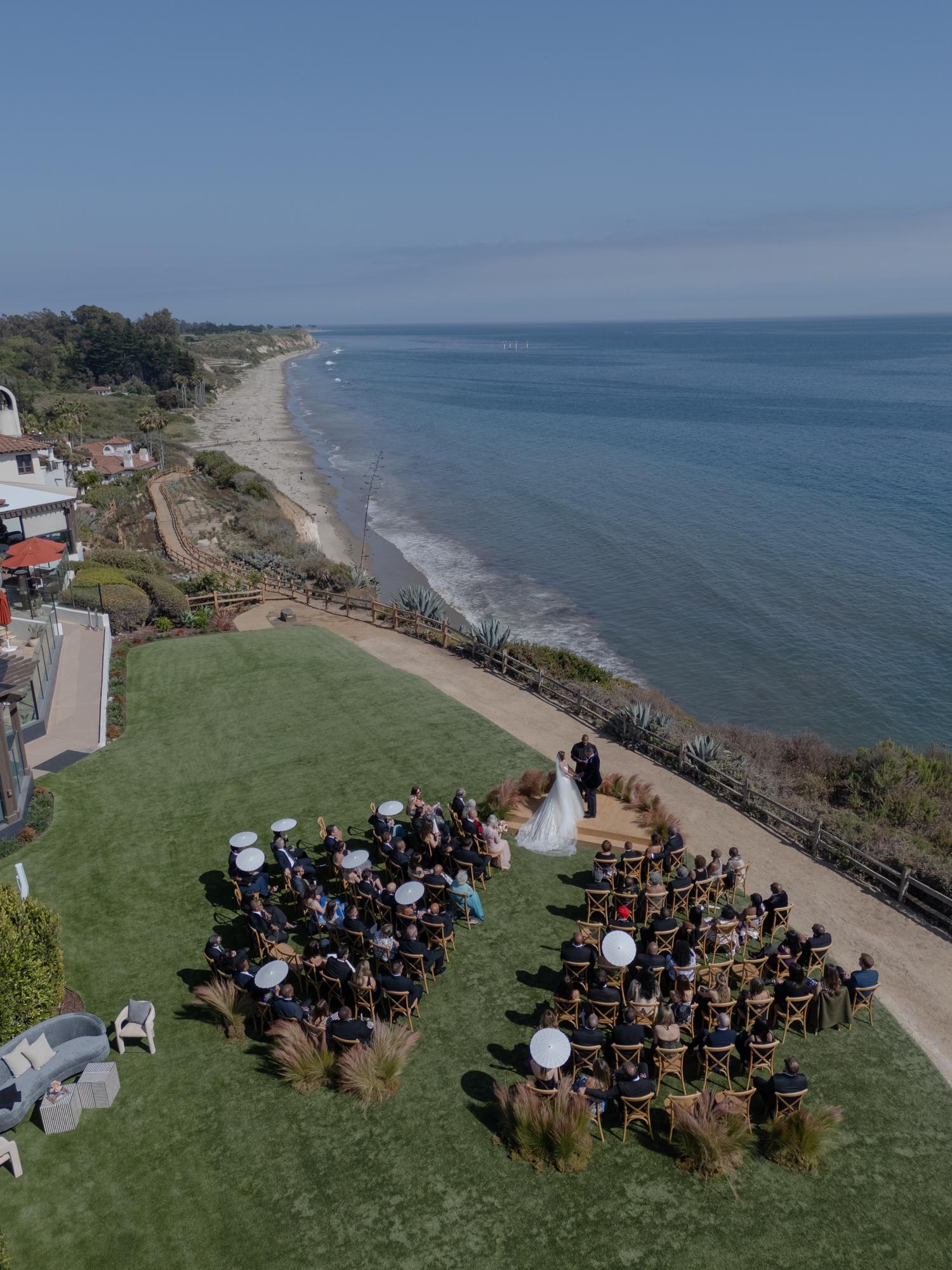
Weather is the one risk every wedding shares, and much of the fall wedding calendar sits inside storm season. The National Hurricane Center puts the Atlantic hurricane season at June 1 to November 30, with its peak on September 10 and most activity falling between the middle of August and the middle of October.1 The eastern Pacific season, which covers the waters off Mexico's west coast, runs from May 15 to November 30.1
A weather clause answers practical questions. Who decides to move to the rain plan, and by what time on the day? What do you need in order to work safely, whether that is cover, dry ground, power, or a wind limit for a tent or a hanging installation? If the day goes ahead in a different form, does your fee change?
Then there is the day that cannot go ahead at all. Contracts usually handle that with a force majeure clause, which Cornell Law School's legal encyclopedia defines as a provision that frees both parties from obligation if an extraordinary event directly prevents one or both of them from performing.2 The same entry notes that courts in some states, New York among them, read these clauses narrowly and excuse only the events the clause actually lists.2
So the list of events in yours matters, and a lawyer can tell you how your state reads it.
Practical step: Write down the last three times weather changed one of your events, and what was decided on the spot. Those decisions are the first draft of your weather clause.
2. Postponement and Cancellation Are Two Different Events
Many contracts handle a couple moving their date and a couple canceling in a single paragraph. The two cost you different amounts, and each deserves a paragraph of its own.
For a postponement, the clause should say how much notice you need, whether the money already paid moves to the new date, and how long the couple has to choose one. It should say that the new date depends on your availability, and what happens if you are already booked. It should also say whether the original price holds when the new date falls in a later year.
For a cancellation, the clause should say what is owed at each stage. A common approach is a schedule that rises as the date approaches, on the reasoning that a date released a year out can be rebooked and a date released a month out usually cannot.
How much of that a court will enforce depends on where you work. Ask your lawyer which terms hold up in your state before you rely on them.
Practical step: Read your current contract and check whether it uses the word postponement at all. If it only covers cancellation, that is the first gap to close.
3. The Payment Schedule: Dates and Amounts
A payment clause that says half up front and the balance before the wedding leaves both of you guessing. A schedule names the amount and the calendar date of every payment.
Set the final payment far enough ahead that you are never collecting on the wedding day. Say what happens when a payment is late: whether a fee applies, how long the couple has to catch up, and the point at which you may release the date. Say which payment methods you accept.
Name the person who is paying, too. When a parent is covering the cost, the person signing the contract and the person sending the money are different people, and your contract should account for both.
One question belongs with your lawyer: what to call the first payment. Ask whether your contract should call it a deposit or a retainer, and whether it can be described as non-refundable in your state.
Practical step: Replace every phrase like "before the wedding" in your payment terms with an exact number of days. Then set a calendar reminder for each due date at the moment a couple signs.

Want to join the Style Me Pretty vendor directory for just $99?
4. Content Usage Rights: Who Can Post What
A single wedding now produces photographs, film, behind-the-scenes clips from a content creator, and phone footage from every vendor in the room. Who is allowed to post which of it is a contract question, and most contracts are silent on it.
Start with what the law already settles. The United States Copyright Office explains that copyright exists automatically once an original work is fixed in a tangible form, and that owning a copy of a work does not make you the owner of its copyright.3 The author is ordinarily the person who created the work.4 For wedding photographs and film, that usually means the photographer or filmmaker, or the studio that employs them.4
If you are the photographer or filmmaker, your contract is where you grant permission. It should say what the couple may do with the images, such as printing them and sharing them online, and what needs your sign-off, such as selling them or handing them to a brand. The Copyright Office notes that a transfer of copyright ownership generally has to be in writing and signed.3
If you are any other vendor, permission to use the photographer's images comes from the photographer, whatever your own contract with the couple says. What your contract can cover is your right to photograph and film your own work on the day, and the couple's permission to appear in your marketing. That second permission touches the right of publicity, the legal protection against commercial use of a person's name or likeness. It is mostly a matter of state law, and only about half the states distinctly recognize it.5
Credit belongs in the clause as well. We have written before about why to credit every vendor, including yourself.
Practical step: Write one sentence for each of three questions: what the couple may do with your work, what you may do with images of their wedding, and how you are to be credited. If your contract cannot answer all three, take the gaps to your lawyer.
5. Artificial Intelligence: Say What You Will and Will Not Do
Editing tools built on artificial intelligence, or AI, can now remove a guest from a frame, change a sky, or alter how a person looks, in a few seconds and on a phone. A couple can do it to a photograph you delivered. So can another vendor. Most contracts were written before any of that was possible.
An AI clause works in two directions. The first is what you promise. Tell couples plainly whether you use these tools in your own work and where you stop. You might promise that you will never use them to add, remove or reshape people in their photographs, and that you will never upload their images to train an AI model.
The second is what you ask. A photographer can ask that delivered images not be altered with AI tools and then published under the photographer's name, since the credit tells the world the photographer made what it is looking at.
"We do not use artificial intelligence to add, remove or alter people in your photographs. We ask that delivered images not be edited with artificial intelligence tools before they are shared or published."
That is the idea in plain words, and a lawyer turns it into wording that holds. The law here is still taking shape, which is one more reason to ask. In a report published in January 2025, the United States Copyright Office concluded that using AI tools to assist human creativity does not affect the availability of copyright protection for the result, and that copyright does not extend to material generated purely by AI.6
Practical step: List every tool you use that has an AI feature, from culling and editing software to the assistant that drafts your emails. Decide what you are comfortable promising about each, then ask your lawyer for clause wording to match.
6. What Happens If You Cannot Be There
Every clause so far covers something going wrong around you. This one covers you. Illness, injury, a family emergency and a canceled flight all happen to wedding vendors, and they happen on Saturdays.
The clause should say what you will do if you cannot perform: send a substitute of comparable skill, refund what has been paid, or some combination of the two. It should say who chooses the substitute and whether the couple has a say. If you work with a team, it should say whether the couple is hiring you personally or your company.
A clause like this is only as good as the arrangement behind it. The vendors who handle an emergency well have already agreed with two or three colleagues to cover for one another, long before anyone needed it.
Your lawyer may also suggest a limit on what you can be held responsible for. That wording is theirs to write.
Practical step: Call two colleagues whose work you would be proud to send in your place and agree to cover for each other. Then make sure your contract describes that arrangement.
The Bigger Picture
Every clause here does the same job. It settles a question months in advance, with both signatures under the answer, so that nobody has to argue about it on a bad day.
Couples tend to read a clear contract as the sign of a careful vendor. The planner, photographer or florist who has thought about rain, a moved date and a missed flight is someone who has done this before.
Take this list to a lawyer licensed in your state, along with your current contract. You will use that document for every booking you take, and an hour of professional review is a small price for it.
Sources
This piece is general information for wedding vendors and is no substitute for advice from a lawyer licensed in your state. The legal references below describe United States law in general terms.
- National Oceanic and Atmospheric Administration, National Hurricane Center, "Tropical Cyclone Climatology," hurricane season dates and peak based on the 1991 to 2020 climate period: https://www.nhc.noaa.gov/climo/
- Cornell Law School, Legal Information Institute, Wex legal encyclopedia, "force majeure," last reviewed May 2025. A law school reference written for general readers: https://www.law.cornell.edu/wex/force_majeure
- United States Copyright Office, Circular 1, "Copyright Basics," revised September 2021: https://www.copyright.gov/circs/circ01.pdf
- United States Copyright Office, Circular 30, "Works Made for Hire": https://www.copyright.gov/circs/circ30.pdf
- Cornell Law School, Legal Information Institute, Wex legal encyclopedia, "publicity." A law school reference written for general readers: https://www.law.cornell.edu/wex/publicity
- United States Copyright Office, "Copyright and Artificial Intelligence, Part 2: Copyrightability," a report of the Register of Copyrights, January 2025: https://www.copyright.gov/ai/Copyright-and-Artificial-Intelligence-Part-2-Copyrightability-Report.pdf
Credits
Photographs from a wedding at The Ritz-Carlton Bacara in Santa Barbara, California, published on Style Me Pretty in September 2026.
Additional credits: Event Planning: Cassandra & Company Weddings | Cake: Lele Patisserie | Makeup: Briana Hurley | Hair: Danielle Roberts | DJ: DJ Michelle Pesce | DJ: DJ Tendaji Lathan | Venue: The Ritz-Carlton Bacara | Illustrator: Andrea del Hoyo | Rentals: Bella Vista Designs, Inc | Rentals: Brass Tacks | Rentals: Bright Event Rentals | Dance Floor: RCD Dance Floors | Rentals: The Ark Event Rentals