What Wedding Vendors Can Learn From the Hospitality Industry
What the research on hotels and restaurants says about service, and five ways a wedding vendor can use it this week.

Hospitality has been measured as carefully as it has been romanticized. Business school researchers have asked its customers what they value. A federal agency has documented how its best-known hotel company trains its staff. Psychologists have run experiments at restaurant tables with real tips at stake.
Wedding vendors do the same kind of work: a service delivered in person, to people who care a great deal about the outcome, with no second attempt. Very little of that research has been translated for them.
Here are five findings worth borrowing, with a practical step for each. Along the way, three vendors we have interviewed show what the findings look like at a wedding.
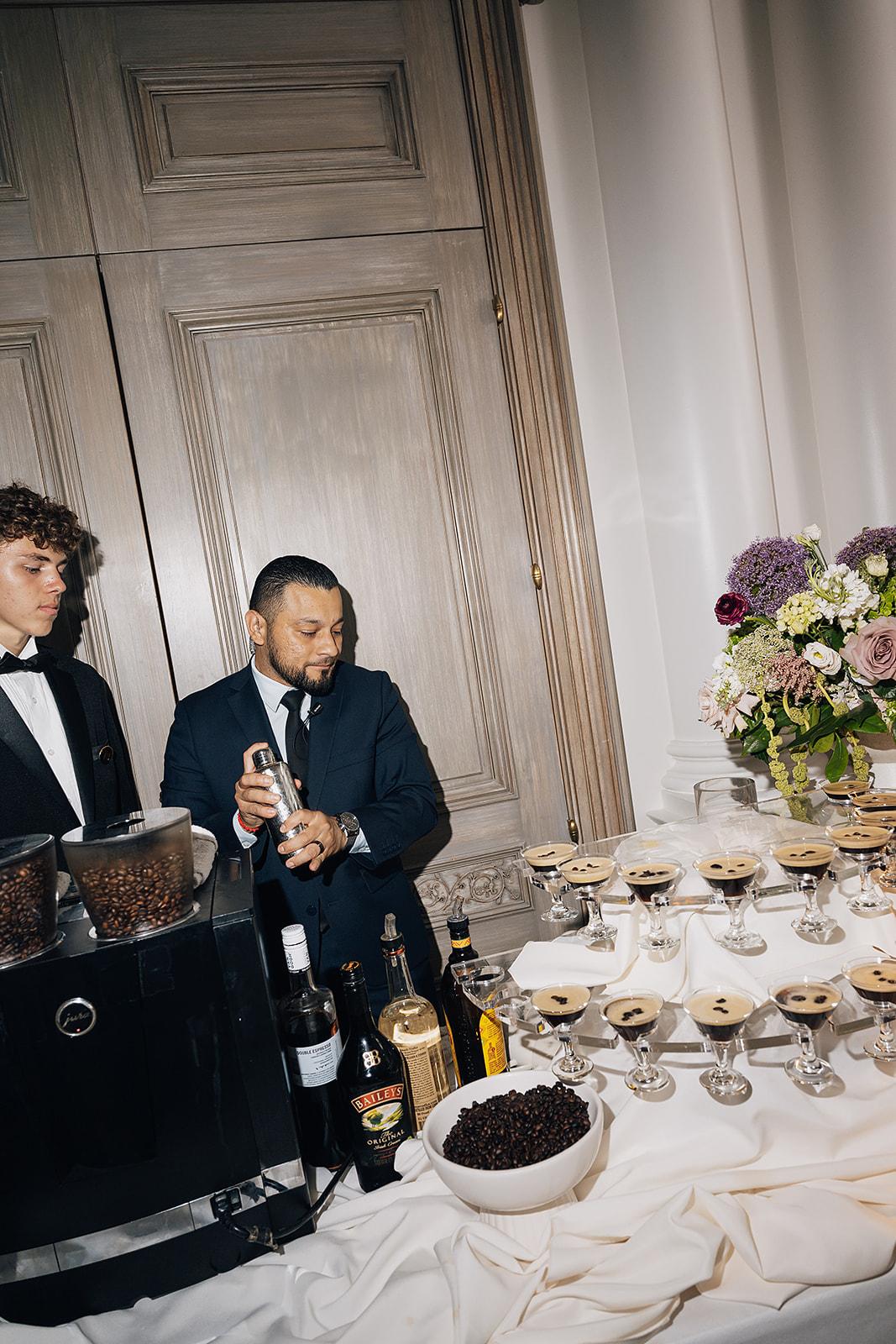
Getting the work right meets a client's expectations. How you deliver it is where they decide what to say about you.
1. Be Reliable First, Then Be Remarkable
In 1991 three researchers, A. Parasuraman, Leonard Berry and Valarie Zeithaml, published a study in MIT's Sloan Management Review built on sixteen focus groups with customers in six service sectors, hotels among them. They sort what customers expect into five dimensions: reliability, tangibles, responsiveness, assurance and empathy. One of the five always wins. In the quantitative phases of their research, they write, "customers have always favored reliability when asked to indicate the relative importance of the five dimensions in judging service."1
The second finding is the one to build on. Reliability, they conclude, is the most important dimension in meeting customer expectations, while the process dimensions, especially assurance, responsiveness and empathy, are most important in exceeding them.1
For a wedding business, reliability is the gallery delivered on the date you promised, the flowers on site at the hour in the contract, the band that plays the first dance the couple chose. The process is everything around it: how fast you answered, how sure of you they felt, whether anyone noticed them.
Michelle Durpetti, a planner who is also a third-generation leader of her family's Chicago steakhouse, puts the same idea in her own terms. "Beautiful design matters tremendously to me, but beauty alone is never enough," she told us. "How a celebration feels, how it flows, and how people experience it are equally important."2
Practical step: Write down the three promises you make to every client: a date, a deliverable and a response time. Check your last five jobs against them before you add anything new to your service.
2. Write Your Standards Down
The Ritz-Carlton is the only two-time recipient of the Malcolm Baldrige National Quality Award in the service category, according to the National Institute of Standards and Technology, the federal agency that publishes the award profiles. Its profile of the company describes how the standards reach the staff. Everyone receives a wallet-sized copy of the Gold Standards, and they are reinforced in a briefing of five to ten minutes at the start of every shift.3
The company publishes those standards. They include Three Steps of Service, short enough to memorize:4
- "A warm and sincere greeting. Use the guest's name."
- "Anticipation and fulfillment of each guest's needs."
- "Fond farewell. Give a warm good-bye and use the guest's name."
Translate that for a wedding business. The greeting is your first reply to an inquiry, with both partners' names spelled correctly. Anticipation is the middle of the job, which the next section covers. The farewell is the easiest one to skip: the work is delivered, the final invoice is paid, and the relationship just stops.
A solo florist does not need a wallet card. The point of the card is that the standard exists outside one person's memory, so it still holds on the fourth wedding of a five-wedding month.
Practical step: Write your own three steps. How is every new client greeted, by name, within a day? What is one thing you do for them before they ask? What is the last thing they receive from you, and does it read as a goodbye or as a receipt?
3. Learn the Client Before They Ask
When The Ritz-Carlton first won the award, in 1992, the agency's profile noted that each employee is trained to note guest likes and dislikes, and that the notes went into a guest history profile covering the preferences of 240,000 repeat guests.5 The 1999 profile says the database lets hotel staff anticipate the needs of returning guests.3 The company's credo ends with a promise to fulfill "even the unexpressed wishes and needs of our guests."4
A wedding vendor rarely gets a returning guest. What comes back is the question. Your fortieth couple will ask what the first thirty-nine asked: when the next payment is due, who gets the timeline, what happens if it rains, when they will see the photographs.
Durpetti treats answering as the job. "Most couples have never planned an event of this magnitude before, and there is no reason they should automatically understand everything that goes into it. That is our job."2 Lynden Lane Co. built a tool for it: a personal landing page for each couple, so nobody has to search for an email about photographers or hunt down a planning timeline. "They need one spot to go back to," says Layne Povey.6
Practical step: List the five questions every client asks in the month after booking. Answer all five in one welcome document, and send it the day the contract is signed.
Pink Friday is on for the rest of November: your first year of a Style Me Pretty Vendor Profile is $49.50 instead of $99, then $99 a year. Ends November 30.
4. Fix It on the Spot
"Hard as they try, even the best service companies can't prevent the occasional late flight, burned steak, or missed delivery," Christopher Hart, James Heskett and Earl Sasser wrote in Harvard Business Review in 1990.7 Something will go wrong at a wedding you work. The research is about what happens next.
The Ritz-Carlton's answer is speed and authority. The 1992 profile says workers are required to act at first notice, whatever the problem, and that other employees must assist when a colleague asks for help with a guest's complaint.5 The 1999 profile adds a number: any employee could spend up to $2,000 to immediately correct a problem or handle a complaint.3 That figure describes the company at the time of its 1999 award. We could not confirm it is current policy. One of the company's published service values still reads, "I own and immediately resolve guest problems."4
Durpetti's rule for a problem during an event has the same order: protect the guest experience, solve the problem, and address accountability afterward. "I am not interested in blame, I am interested in solutions," she says.2 The Lockharts, a photography and film studio, describe the vendor's version: adjusting their approach around a design installation, helping navigate an unexpected timeline change, or flagging a potential issue before it reaches the couple.8
Practical step: Decide now what you can fix on the spot without asking anyone: a reprint, an extra half hour, a replacement arrangement. Tell everyone who works for you where the limit is, so the fix happens at the wedding and the conversation about cost happens on Monday.
5. Use Their Name, and Make One Small Gesture
Restaurants are where the small things have been tested. In a 1990 experiment, 42 two-person parties at a buffet brunch were randomly assigned to a server who either introduced herself by name or did not. The tipping rate was 23.4 percent when she did and 15.0 percent when she did not.9 It was one restaurant and a small sample, and the direction is hard to ignore.
A 2002 study found that customers who received a small piece of chocolate with the check tipped more than customers who received none, and that tips varied with the amount of candy and with the manner in which it was offered. The authors argue that reciprocity explains it.10 Cornell's Michael Lynn, one of that study's authors, later collected twenty tested techniques for servers, among them introducing yourself by name, calling the customer by name and giving the customer candy.11
A tip is not a booking, and nobody should hand a couple a mint. The finding that travels is that a name and a small, unexpected gesture change how people feel about the person serving them.
Restaurateur Will Guidara tells the best-known version in a TED talk recorded in September 2022. During a busy lunch in early 2010, he was clearing plates from a table of four "foodies on vacation to New York" when he heard one say, "the only thing we didn't get to try was a New York City hotdog." He "literally ran out the front door and down the block to the hotdog cart," had the kitchen plate it, and presented it: "To make sure you don't go home with any culinary regrets, a New York City hotdog." He says nothing he had ever served got a better reaction, because the gesture was specific to those four people.12
Wedding work is full of openings for this. The Lockharts told us they have raised the standard of their client welcome gifts as part of becoming more intentional about the entire client experience.8 Lynden Lane starts further back, by getting to know a couple's lifestyle rather than what they want their wedding to look like.6
Practical step: Add one line to every client file for something they mention in passing: the dog's name, the song from the proposal, the grandmother who cannot travel. Use it once, somewhere they will notice.
The Bigger Picture
The restaurateur Danny Meyer drew the line between the two halves of this piece in his book Setting the Table, as quoted in a profile his company republishes. "Service is the technical delivery of a product," he wrote. "Hospitality is how the delivery of that product makes its recipient feel."13
That is the Sloan finding in plainer words. The technical delivery is reliability, and it comes first. No welcome gift rescues a late gallery. How the delivery feels is the process, and it is where a client's expectations get exceeded.
The evidence has limits worth stating. The tipping experiments are small and come from restaurants. The Ritz-Carlton profiles describe a hotel company with thousands of employees and a training budget to match. What transfers to a business of one or five is the habit: decide the standard, write it down, learn the client, fix problems fast, and notice people.
Durpetti's interview offers a list that covers all five: "Listen carefully. Communicate clearly. Respect the investment. Prepare thoroughly. Surround yourself with talented people. And never underestimate the importance of making someone feel genuinely cared for."2
Print it, and put it where you answer email.
Sources
- A. Parasuraman, Leonard L. Berry and Valarie A. Zeithaml, “Understanding Customer Expectations of Service”, Sloan Management Review, Spring 1991. Sixteen focus groups with customers in six service sectors; the reliability ranking refers to the authors' earlier quantitative studies. https://sloanreview.mit.edu/article/understanding-customer-expectations-of-service/
- Pretty Perspectives, “Beyond Beautiful: Michelle Durpetti on the Art of Hospitality”, October 22, 2026. https://perspectives.stylemepretty.com/michelle-durpetti-on-planning-weddings-like-a-restaurateur/
- National Institute of Standards and Technology, Baldrige Performance Excellence Program, “The Ritz-Carlton Hotel Company, L.L.C.”, 1999 award recipient profile. The $2,000 figure is from this profile and describes the company at that time. https://www.nist.gov/baldrige/ritz-carlton-hotel-company-llc
- The Ritz-Carlton Leadership Center, “Gold Standards”: the Credo, the Three Steps of Service and the Service Values as the company publishes them. https://ritzcarltonleadershipcenter.com/about-us/about-us-foundations-of-our-brand/
- National Institute of Standards and Technology, “Malcolm Baldrige National Quality Award 1992 Recipient: The Ritz-Carlton Hotel Company”. https://www.nist.gov/system/files/documents/2017/10/11/1992_The_Ritz-Carlton_Hotel_Company.pdf
- Pretty Perspectives, “How Lynden Lane Makes Weddings Feel Like Home”, November 9, 2026. https://perspectives.stylemepretty.com/how-lynden-lane-makes-weddings-feel-like-home/
- Christopher W. Hart, James L. Heskett and W. Earl Sasser, Jr., “The Profitable Art of Service Recovery”, Harvard Business Review, July-August 1990. https://hbr.org/1990/07/the-profitable-art-of-service-recovery
- Pretty Perspectives, “What The Lockharts Learned From Their Own Wedding Photos”, October 19, 2026. https://perspectives.stylemepretty.com/what-the-lockharts-learned-from-their-own-wedding-photos/
- Kimberly Garrity and Douglas Degelman, “Effect of Server Introduction on Restaurant Tipping”, Journal of Applied Social Psychology, 1990. A randomized field experiment with 42 two-person parties at one restaurant. https://onlinelibrary.wiley.com/doi/10.1111/j.1559-1816.1990.tb00405.x
- David B. Strohmetz, Bruce Rind, Reed Fisher and Michael Lynn, “Sweetening the Till: The Use of Candy to Increase Restaurant Tipping”, Journal of Applied Social Psychology, 2002. https://onlinelibrary.wiley.com/doi/10.1111/j.1559-1816.2002.tb00216.x
- Michael Lynn, “Mega Tips 2: Twenty Tested Techniques to Increase Your Tips”, Cornell University Center for Hospitality Research, 2011. https://hdl.handle.net/1813/71274
- Will Guidara, “The secret ingredients of great hospitality”, TED@BCG, September 2022, official transcript. https://www.ted.com/talks/will_guidara_the_secret_ingredients_of_great_hospitality/transcript
- Robert Klara, “The Secret to Danny Meyer's Exceptionally Good Taste”, as republished by Union Square Hospitality Group, quoting Danny Meyer, Setting the Table. https://ushg.getbento.com/news-item/secret-to-success/
Credits
Photographs from A Muddled Berry and Sage Green Chateau Wedding in New Brunswick on Style Me Pretty, photographed by Mesus Studios.
Additional credits: Event Design: LVL Four | Event Planning: LVL Four | Floral Design: Fiore Designs | Stationery: The Coral Reef Studio LLC | Beauty: Glowbyyj | Beauty: GlambyMaame